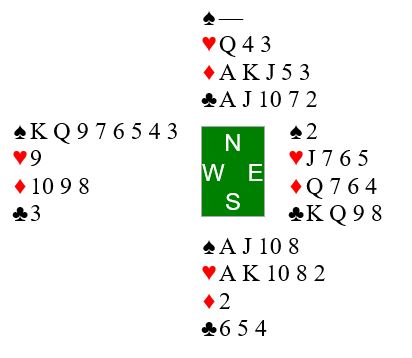
Here is one I stuggeled with a bit. You are in six hearts. Opening lead is the king of spades. Your mission is to make six hearts against any defense. Have fun!
Hilo Bridge Club Updates
Here is one I stuggeled with a bit. You are in six hearts. Opening lead is the king of spades. Your mission is to make six hearts against any defense. Have fun!
See update below.

Once you have answered that question, you must decide how to reduce the number of losers while managing the trump suit. Give it some thought and I will elaborate later today.
Update: Overtricks are important in our pairs game. Whats’ you best chance to make three or four spades?
It looks like you have two potential losers in the trump suit, none in hearts, one in diamonds, and two in clubs. That gives you five potential losers. It looks like there is nothing you can do about losers in diamonds and clubs. How do you plan to manage the trump suit for no more than one loser?
Best chance is to finesse left hand opponent for the remaining two spade honors. If she has just one of them, you will reduce your potential spade losers to one. If she has them both, you may avoid a spade loser altogether. Use those hearts for entries to take spade finesses (it’s okay to overtake the king with the ace). You still don’t have any heart losers.
Question: What would you do differently if the queen of clubs was a small club?
BTW, did you make a mental note of who has the remaining honors in hearts? And how many hearts do you think that player has? Did you use apply the rule of 11 at trick one?
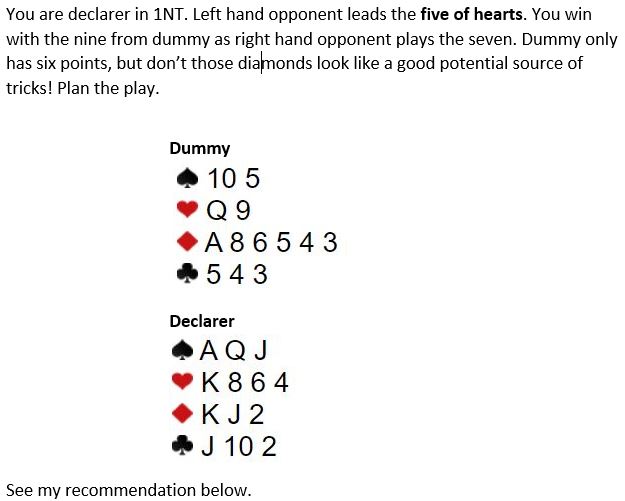
Recommended line of play: You have a nine card diamond fit, so dummy’s diamonds should run if they split no worse than 4-0. You are in dummy, having won with the nine of hearts. Play a low diamond from dummy and insert the jack. Even if it loses to the queen, you know the diamond split is no worse than 3-1. And the remaining diamonds are sure to take tricks. You see how, don’t you? If not, please ask me.
When I observed the play on this hand declarer led the ace of diamonds at trick two, playing the two from his hand. It was not possible to recover after that. Bottom line: It’s right to recognize diamonds as your source of tricks, but make sure you retain an entry (the ace of diamonds in this example) to cash them.
You are South holding this hand:
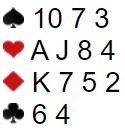
Opponents are silent. Partner opens one club in 4th seat. You respond one heart. Partner’s rebid is one spade. Your rebid bid is 1NT. Partner raises you to 3NT, making you declarer in 3NT. Opening lead is the jack of clubs. This is what you see when dummy comes down. How should you play?
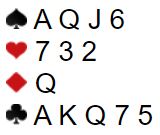
You count your sure tricks: one spade, one heart, and three clubs for a total of five. Where are the other four likely to come from? If clubs break no worse than 4-2, you can develop one more trick in clubs. You will get one more trick in diamonds once the ace is dislodged. If the spade king is onside, you can develop at least two more tricks in spades. That’s probably the best you can hope for, since you are at risk in the diamond suit and there is too much to do in hearts.
You win the first trick with the ace of clubs and cash the king of clubs. You are happy to see right hand opponent follow suit with the deuce and nine. Clubs are breaking 4-2 as you had hoped. Now you cash the queen of clubs and throw left hand opponent in with dummy’s five of clubs.
Worst thing that can happen now is that left hand opponent shifts to a diamond. Say she does so and right hand opponent wins the ace and continues with the eight. You win the king, and now it’s time to test the spades.
Lead the 10 of spades to make sure you are still in hand for another finesse if left hand opponent ducks. If the finesse wins, you are going to get your nine tricks.
Pointers:
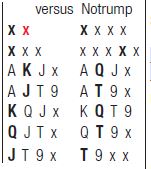
Questions?
Usually when playing a notrump contract, you aim to set up a long suit for more tricks. Setting up the suit requires that you have an entry to it once it is set up. And you often must give up a trick or two before your long suit gets set up. Here is a recent example:
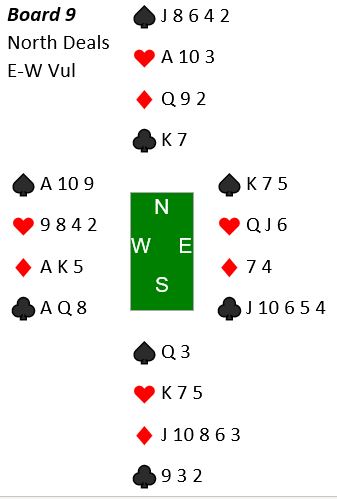
You are West in 3NT, and the opening lead is the spade four (4th highest from opponents’ longest suit). Counting your tricks, it looks like you have three sure spade tricks, two sure diamond tricks and one sure club trick for a total of six tricks. Once you drive out the king of clubs, the club suit looks like it may be a good source of more tricks.
But be careful of your entries to the clubs. The king of spades is a sure entry, so don’t squander it early. Win the opening lead in hand (you did play low from dummy didn’t you?). Start the clubs by leading the ace and then the queen. The only time you will have difficulty in setting up clubs for four tricks is the unlikely holding of all five missing clubs by one defender. As the cards lie you will easily take three spade tricks, two diamond tricks, and four club tricks for nine total.
You are West in 3NT and opening leader leads the four of spades (4th highest of her spades). Here is your hand and East’s dummy:
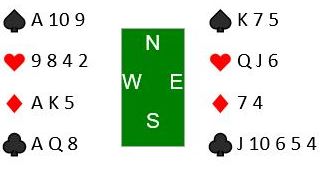
How many tricks do you expect to take in spades? The rule of 11 gives you the answer. By subtracting the rank of the suit led (the four) from eleven, you know how many cards higher than the four are held by you, dummy, and right hand opponent. 11 minus 4 equals seven. You can see six cards higher than the four: A 10 9 K 7 5. That means right hand opponent only has one card higher, so it must be the queen, the jack, the eight, or the six. When you play low from dummy you will know for sure which one it is. If it’s the eight or the six, your nine will win the trick. If it’s the queen or the jack, you will win the trick with the ace, and be in position to take a sure winning finesse against North’s remaining honor.
So, to answer the question, application of the rule of 11 informs you that you have three sure spade tricks.
You are South in 1st seat with this hand:

Do you pass, open the bidding one club, or open with a preemptive three clubs? This hand looks too good to pass or preempt.
There is a good guideline known as the “rule of 20” to assist in your decision. First add the number of cards in your two longest suits (7 clubs plus 4 spades equals 11 for this hand). To that total add your high card points (three queens plus an ace equals 10 points for this hand). If the total (11 plus 10 for this hand) is equal to or greater than 20 (21 for this hand), open the bidding.
Question: Would you open the bidding if your queen of clubs was the jack? Application of the rule results in exactly 20. However, most experts recommend that you need to hold two quick tricks to open when your total is exactly 20. For this hand you have only one quick trick: the ace of clubs.
That being said, I still recommend you open this particular hand one club. Examine the hand, recollecting that the queen of clubs is instead the jack. The hand is loaded with helpful intermediates (10s and 9s). The hand is likely to win at least 5 tricks in clubs ane one in spades — six tricks! Don’t you think that’s worth an opening bid?
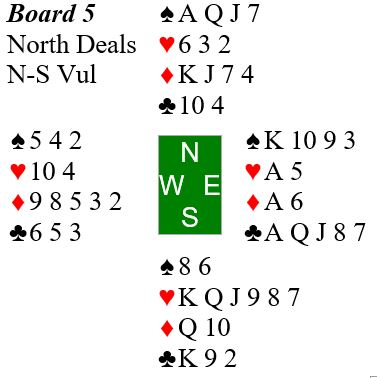
Here is an intereting hand from Sunday. I was sitting South. Right hand opponent opened one club in 2nd seat. Since my partner was a passed hand, I decided to preempt with two hearts. In retrospect (retrospect is always easy when you can see all four hands) I have an opening hand. My king of clubs is well placed behind the opening bidder. It was a mistake to preempt.
I should have overcalled one heart. When left hand opponent passes my partner will advance with either two clubs (showing limit raise in hearts) or three hearts (actual limit raise in hearts). What kind of agreement do you have on this situation? Make sure you discuss it with partner
If I had not lied to partner about my strength, we would get a good board by competing to three hearts or by doubling East if she gets too agressive with her 18 point hand.
Do you agree with my assessment? Try to think about it from South’s viewpoint. South cannot see all the hands.
BTW, East has a hand that qualifies for a reverse. It’s unbalanced (nine cards in the black suits) and big (18 points).
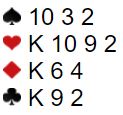
Partner opens one diamond in 1st seat, right hand opponent passes, and it’s your turn. You hold a nice nine points with those three kings, including that K 10 9 fourth holding in the heart suit. Also, you have help in partner’s diamond suit. Should you respond one heart or one notrump?
I recommend a response of one heart, staying disciplined about responding “four card majors up the line”. It’s true that you have a balanced hand, but partner may not. You don’t want to miss the golden 4-4 fit in hearts if there is one. If partner turns out to have a balanced hand, you can always land in a notrump contract.
I held this hand in 3rd seat with two passes to me (none vul).
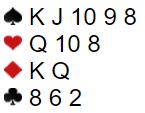
I have a nice 11 points. It’s nice because of that sequence of intermediates in the boss suit. I could pass, open it one spade, or do something a bit more agressive? What do you think I should do?
Even though I only have five spades, I decided to open it an aggressive two spades. It looks like I have a good prospect of four tricks in spades plus one trick in diamonds. And unless left hand opponent holds a rock crusher, partner should be able to help out with a trick or two. If left hand opponent does have the rock crusher, I have made it difficult for her to find their side’s best strain or level.
Here is another hand I observed recently. Two passes to you. What is your opening bid?
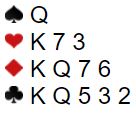
It’s a nice hand, and you should open it. But when considering your opening bid, be sure to plan your rebid. If you open one club, what will your rebid be when partner responds one spade? Two clubs would promise at least six clubs. One notrump would promise two or three spades. Two diamonds (a reverse) would show an unbalanced hand of 18 points or more. The smallest lie of those possibilities is probably two clubs.
But if you instead open one diamond, you now have an easy rebid of two clubs. You would like to have equal or greater length in the diamond suit. But it’s a smaller lie, conveying the shape and limited strength of your hand.
You hold this hand in 4th seat after three passes:
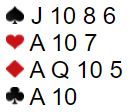
Is it good enough to open 1NT? Yes, you have 15 high card points in a balanced hand and, its bolstered by four 10s. Open it 1NT.
When I observed the hand in play recently, it was opened one diamond. The bidding ended in 1NT, making three for a bottom board. All other pairs got to 3NT, making three or four.
Update: Emails went out from ACBL on Sunday to all players who are members and have email addresses in ACBL database. Hat tip to Walter for insight on how to change to the correct notification.
The posted results are still a bit confusing. Here is how they were displayed yesterday:
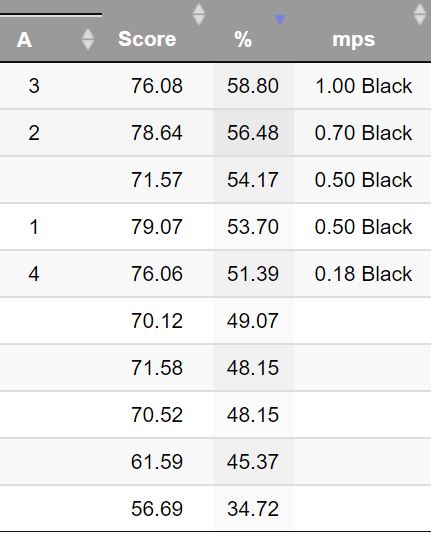
The “A” column displays the standings after handicaps are added. Similarly, the “score” column displays matchpoint scores after handicaps are added. But the “%” column displays pre-handicap percentages.
For example, you see the pair in the first row finished in 3rd place after adjustment for handicap, had a matchpoint score of 76.08 after adjustment for handicap, but finished in 1st place with a pre-handicap percentage of 58.80. The ordering of the results from top to bottom are based on pre-handicap percentages.
I hope that clears up the confusion a bit. Let me know if you have any questions.
Your partner opens one diamond in third seat, and right hand opponent passes. What is your response holding:
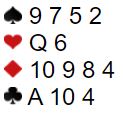
Bid one spade promising four or more spades. Do not bid two diamonds. Four card majors up the line in response to partner’s opening bid of one of a minor! You are seeking the 8-card golden fit in a major (spades in this example).
Your partner opens one diamond in 1st seat and your right-hand opponent overcalls one heart (both vulnerable). You hold this crummy hand.
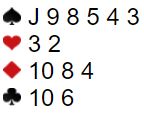
Do you pass or bid? This really is a bad hand: two ugly doubletons and only one point. Even so it may be worth competing. You have a diamond fit and six cards in the boss suit. I recommend you make a weak jump shift to two spades. It will hinder opponents’ communication, set the stage for a potential sacrifice, and convey that message to partner. But if you are going to compete with this kind of hand, you must agree with partner beforehand. Discuss it when you are going over your convention card before the game. Here is the relevant section in lower right portion of the convention card:

The box to right of “weak jump shifts: in comp” should be checked. Note that it is in black, so not alertable (weak jump shifts in competition have become standard practice).
When I held this hand it worked out well. We sacrificed in four spades when the opponents could make four hearts.
You are in 3rd seat. What is your opening bid with this nice hand?
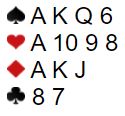
You have a balanced hand with 21 high card points. Open it 2NT. Don’t worry about the doubleton club. It’s best to describe your strength (20-21 points) and shape with one bid. Partner will know what to do.
If partner responds three clubs (Stayman), you will rebid 3 hearts. Then if partner tries to sign off in 3NT, you will bid four spades. You know from partner’s Stayman response that she has a four card major, and it must be spades. The golden major suit fit gives you a better chance for making game and and possible overtrick(s) than 3NT.
Note that you should bid hearts first in reply to partner’s Stayman inquiry with 4-4 major suit holding.
As I watched our Swiss Teams last week, I noticed that intermediate players are not routinely giving partner count on defense. Here is one such situation when you are defending a notrump contract:
Partner has made the typical opening lead from a long suit that she would obviously like to set up. Subsequently you are in and are ready to return her suit. As you do so you would like partner to know the number of cards you presently hold in her suit. Why does that matter, and which card do you play when returning her suit?
It matters because partner wants to discern if the suit is ready to run and if there are any remaining impediments to getting all your available tricks. You can convey that information by the card you choose.
This example from a recent hand should clarify. I was in 3NT and West gets the defense off to a great start by leading the four of hearts:
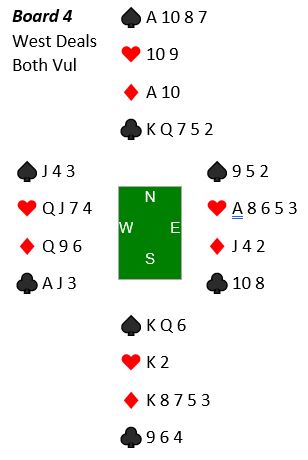
I can see right away that I am going down. EW know from the bidding that I hold two or three hearts, and I know they are going to continue the suit. I know hearts are 5-4, although I cannot tell whether it is West or East who started with five hearts. EW are going to cash four hearts and the ace of clubs. My only hope is that somehow they manage to block the heart suit.
East wins the ace and is ready to return a heart. Do you see why it’s important for West to know how many hearts East has? It’s important because, as the card lie, West will need to play an honor under my king or else the heart suit it blocked. If West can discern that East is returning a heart from a present holding of four hearts, she will know it’s necessary to hold onto the seven. Otherwise she cannot get back to East’s hand, so that East can cash the last heart.
Which card should East play, so that West knows to unblock an honor? Playing a low card from you present holding shows an odd number, and playing the highest card you can reasonably afford (not the eight!) shows an even number. In this case East should return the six of hearts to let partner know she presently holds four hearts.
What happened in real life? West played the seven under my king and the hearts were blocked. I made an underserved 3NT.
Here is a fun, freak hand I held the other day. I am in 1st seat facing favorable vulnerability:
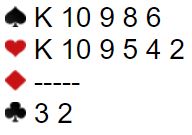
I can’t open a preemptive 2 hearts when holding four or more spades. Instead, how about opening one heart? Okay, I do like holding the K 10 9 in each major, but that’s not enough to justify opening one heart with only six high card points. However, with 11 cards in the majors I don’t plan to go quietly into the night as the auction progresses (unless it becomes clear there is no fit with partner for either major).
Here’s how the auction proceeded until it got back to me:
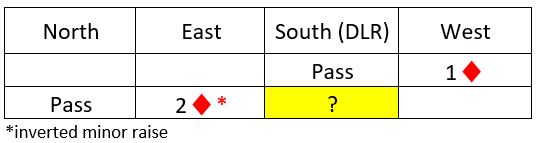
At that point it looks like there is high likelihood of major suit fit with partner, so I overcalled three diamonds (Michaels cue bid for the majors). West bid four diamonds passed back to me. Having better hearts than spades I competed to four hearts ending the auction. When play ended I had made four hearts for plus 420!
Bottom line: Points Schmoints — this kind of a freak hand is much better than its high card holding suggests. It’s loaded with tricks. Those low cards in the majors are going to take tricks even though they don’t contribute to your high card count.
You are West on lead after this auction:

Here is your hand:
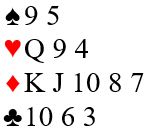
What card do you choose and why? Is it best to make an attacking lead or should you go passive and lie in wait with those nice diamonds? How many spades does declarer have? How many spades does partner have? Scroll down to read my recommendation.
I would go passive and lead a spade. You are unlikely to win a spade triick unless partner has the ace. Opponents have a 8-card fit in spades. Sit back with the KJ10 of diamonds behind the big hand. Your Q9 of hearts and even the 10 of clubs may be useful to your side on defense. Make declarer do all the work.
Here’s another one for you double dummy aficionados.
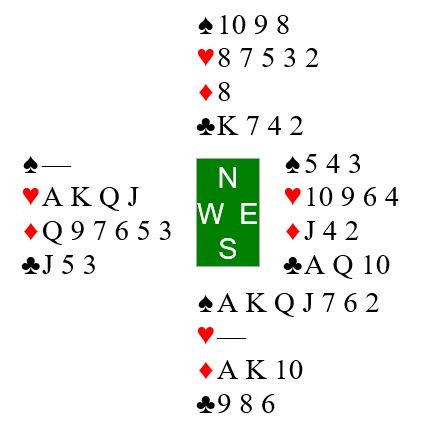
You are South in a contract of five spades. West leads the ace of hearts. That is the last error the defense will make, and they are not happy about it. It looks particularly ominous for you on Halloween Night: The ace, queen, jack, and 10 of clubs have your king trapped should West obtain the lead. Maybe you can somehow dig up an 11th trick in the graveyard.
First club member with fewer than 1,000 MPs to send me the solution wins a free play and recognition in our Double Dummy Solvers’ Honor Roll.