Congrats to Robin McDuff for solving the remaining double dummy puzzle. Robin wins a free play and joins Tor on our Double Dummy Solvers’ Honor Roll. I will be posting the solution along with useful principles of declarer play to be gleaned from it.
Your left hand opponent opens one spade. Partner passes and right hand opponent responds 2NT (alerted as a game forcing raise with at least four spades). The bidding ends when left hand opponent bids four spades (fast arrival with a minimum opening bid). It’s your lead holding:
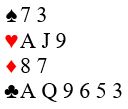
Here is where I see too many players go wrong. You’ve probably heard “never underlead an ace against a suit contract. But if you really think it’s the suit to lead, then plunk down the ace”. That’s great advice. Don’t underlead one of your aces!
But coupled with that advice is “it’s usually not a good idea to plunk down an ace on opening lead, because aces are meant to capture kings and queens. When aces are led, they instead draw deuces and treys.” For your hand in this problem do you see any reason to lead one of your aces?
I don’t. There seems to be no reason to be in a hurry with your aces. It looks like you will always get two tricks with them. I suggest going passive and leading a trump. The opponents have nine trumps and it’s unlikely that your side has a trump trick. Make declarer do all the work.
When I saw this hand played the opening leader plunked down his two aces, and declarer made four spades even though partner had one sure trick. Had opening leader instead saved those aces, he would have captured the king of clubs with his ace, setting up another trick for the defense. Leader’s mistake on the first two tricks cost his side a swing of 15 IMPs!
You are dealer (vulnerable vs not vulnerable). What is your call with this hand?

You have 12 high card points, but only one quick trick (the married KQ of hearts). This hand is too big a lie to open the bidding. Pass!
Congratulations to Tor Thorsen for solving the first two double dummy problems. Tor wins two free plays and is first to receive recognition in HBC’s Double Dummy Solvers’ Honor Roll.
The rest if you better hurry, because Tor is working on the third one.
See undate below.
Your right hand opponent opens the bidding two clubs in 3rd seat. You pass, and left hand opponent makes a waiting response of two diamonds. Right hand opponent rebids 2NT (22-23), and left hand opponent signs off at 3NT.
Now it’s you lead to 3NT holding

Your thoughts?
Start counting. Declarer has 22 to 23 and you hold 8. That leaves 9-10 between your partner and dummy. Dummy raised to game, so should have at least 3-8 points (did not make 4NT slam invitation with 9-10). Opponents showed no interest in the majors.
What do you lead and why?
Update:
I would lead the six of spades, hoping that partner has the jack or that declarer cannot tell who has the king or queen of spades. Anything else loses timing advantages on defense. Don’t even think about leading the three of clubs on that bidding.
Your partner opens one diamond in 1st seat. Right hand opponent passes. Plan your response and subsequent rebids holding this hand:
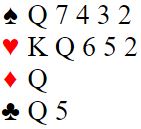
Remember that when you are 5-5 in the majors you respond one spade first, leaving you with an easy rebid of hearts at your next turn. But a pleasant surpise, partner raises your one spade response to two spades. Now what?
You have a spade fit and that five card heart suit headed by king-queen is great feature. One or two of those little hearts should be winners. I recommend you raise to four spades immediately. You should have a good play for game.
Tuesday I analyzed the play of a slam, concluding it had 75 percent plus chance to make.
But what if all of the relevant honors were indeed offside? In Tuesday’s hand that would place the ace of diamonds, the queen-ten third of hearts, and the king-jack of clubs offside. The deal would look like this. Update: thanks to Tor for pointing out error in the posted deal. I corrected it. Here is the corrected deal:
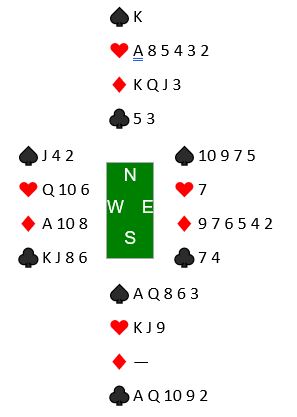
Now that you see all the hands can you find a way for South to make six hearts?
First HBC member with fewer than 1,000 masterpoints to solve this double dummy problem wins a free play and recognition in the HBC Double Dummy Solvers’ Honor Roll.
If you feel adventursome, propose your solution in the comments. Otherwise email the solution to me and I will get back to you.
I am offering the same prize to two previous Double Dummy problems that are still keeping HBC members awake at night: here and here.
You are in 4th seat (vul vs not vul) and there are three passes to you. You have this nice hand:
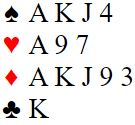
Before opening the bidding you plan your rebid. What is your opening bid?
If you open one diamond, your partner may pass with a bad hand. But you may have a good play for game if your partner holds as few as three of the seventeen missing points.
If you open two clubs, your partner will respond two diamonds. A rebid of two spades would be a big lie, promissing nine plus tricks and a long spade suit. Raising diamonds does not sound right because you don’t want your bid hand to come down as dummy.
Best in my opinion is to open two clubs, planning to rebid two notrump (22-23 points) after your partner responds two diamonds. It’s a bit of a lie because of the singleton, but here are the advantages:
- Your partner will know within one-half point the high card point assets of your side.
- Systems are on (transfers, Stayman). Partner will know how to get to the best strain and level (game or part score).
- Since opener will be declarer, it is unlikely that the king of clubs will be captured on opening lead. Opponents cannot see your hand.
Have I missed something?
See update below
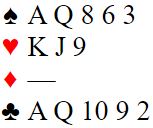
You end up in six hearts (opponents are silent) and left hand opponent leads the 10 of spades. Here is what you see after the lead:
Dummy
You
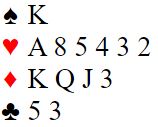
This is a good slam. What is your best chance to make it? Give it some thought and I will update a little later today.
Update: Counting your losers, you see one possible heart loser, one possible club loser and one possible diamond loser. You can avoid the club loser by pitching a low club on one of dummy’s spade winners.
One way to avoid the heart loser is to finesse for the queen of hearts, a 50 percent chance. Another way is to play the ace and king of hearts, hoping to drop the queen (a 52 percent chance missing four hearts). Playing for the drop has a little better chance of avoiding the heart loser.
Can you still make the slam if you don’t drop the heart queen? Yes, it depends on the location of the ace of diamonds. If left hand opponent has the ace of diamonds, you can finesse her for it by leading the king. If she does not cover the king with the ace, pitch a spade from dummy and hope she has the ace. If she does cover with the ace, you ruff in dummy (this is known as a ruffing finesse). If she does not have the ace you are down one. There is a 50 percent chance she has the ace.
Bottom line: This is a parcentage slam. It will make if you drop the queen of hearts or if the ruffing finesse in diamonds is successful. The likelihood of making the slam is roughly 77 percent.
Your partner opens 1NT (15-17) in second seat, and it’s hard for you to believe that you have this huge hand:
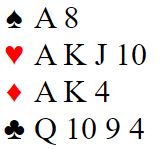
Where do you go from here? If your partner has 16 or 17 high card points you should be in a grand slam (16 plus your 21 equals 37, minimum for a grand). But what if your partner opened with 15 HCP?
Holding 15 points, it’s possible that your partner opened missing the ace of clubs, in which case you want to sign off in the small slam (15+21+4 for the ace equals 40). You will find that out by using the Gerber convention.
Once you are assured that partner holds the ace of clubs, she must have at least 11 other high card points. That leaves the opponents with at most four high card points, which must come from these cards: spades K Q J, hearts Q, diamonds Q J, and clubs K J. Those four points will be from either a queen and both jacks, or two queens, or a king and a jack. It looks like you will have a good play for the grand with most of those possible combinations. Notice that your hand is bolstered by the 10 9 of clubs and the married J 10 of hearts.
But shouldn’t you just be conservative and settle for the small slam. No, you should go with the percentages. Thats what the good players will be doing, so making an overtrick in a small slam is likely to award fewer than 50 percent of the matchpoints.
You are delighted to pick up this 19 HCP hand:
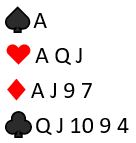
Keeping in mind the prime consideration when opening the bidding is planning your rebid, what is your opening bid?
With a hand this big you can be comfortable bidding your suits in natural order, meaning longest suit first. You plan to open one club and bid diamonds at your second turn, even though diamonds rank higher than clubs. That way you show your big, unbalanced hand (in this example at least nine cards in the minors with clubs longer than diamonds).
Bidding a suit at the two level that ranks higher than the one you opened is known as a reverse. It shows a strong (17+ points), unbalanced hand. Do you see the logic of making sure you are strong before reversing?
Logic: Reversing forces responder (who may have a weak hand) to take the suit preference at the three level, but if opener had started with the higher ranking suit (diamonds in this example) and rebid the lower ranking suit (clubs in this example) responder can choose at the two level.
Change the hand a little, so that it looks like this:

Now your hand is balanced, but you still have 19 points. It’s too good to open 1NT and not quite good enough to open 2NT. This happy dilemma is often characterized as a “one and one-half NT opening bid”. Keeping in mind the prime consideration when opening the bidding is planning your rebid, what is your opening bid?
By opening one of a minor (my preference is one club), you can plan to jump to 2NT at your second turn. The jump to 2NT describes a balanced hand whose strength lies precisely between 1NT and 2NT opening bids, namely 18-19 high card points and balanced. Perfect! Your partner will know the partnership’s high card point assets within one-half of a point.
Question for future consideration: How would you open these two hands with same shape but in the range of 12-14 high card points?
You are East in four spades. You dealt and opened one spade, partner responded two diamonds and you signed off in four spades with your six likely spade tricks plus the ace of hearts. South leads the seven of hearts. How do you plan to play?

Start by counting your losers. You have one club loser and one potential diamond loser. Spades will break 2-2 almost 41 percent of the time and 3-1 almost 50 percent of the time. When spades break 3-1 the queen will be singleton 1/4 of the time. By playing spades from the top the queen will drop 53 percent of the time, so it’s best to play for the drop in spades.
Assuming the queen does drop, what’s your best play for overtricks? You have finesses availabe for the ace of clubs and the king of diamonds.
The order in which you take the two finesses makes a difference. It’s best to finesse for the ace of clubs first. If it loses you can still fall back on the diamond finesse. But if you took the diamond finesse first and it lost, defenders could cash the ace of clubs immediately, holding you to 11 tricks. If the club finesse wins you can attempt the diamond finesse for 13 tricks. If it loses, you are still able to attempt the diamond finesse for 12 tricks.
Recommended sequence of plays: Let the opening lead ride around to your ace-jack of hearts (a free finesse). Cash the top two spades. When the queen drops begin by finessing for the ace of clubs as described above.
You hold this hand:
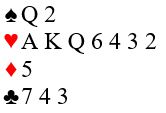
RHO passes in 1st seat, and you open the bidding one heart. LHO passes, partner responds one spade, RHO passes, and it’s time for your rebid. How good is your hand? What do you do?
You may have “only” 11 points, but it looks likely that you have seven tricks in hearts. Points Schmoints! I recommend you invite game in hearts. Three hearts is invitational. Two hearts is too timid.
Your left hand opponent opens the bidding with two hearts, partner passes, and right hand opponent raises to four hearts to end the bidding. Partner leads the ace of spades (ace from ace-king) and you see this huge dummy:
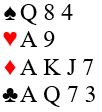
Your crummy hand:

Dummy plays a low spade. What spade do you play and why?
When I saw this hand played defender played the deuce of spades and then played the five as partner cashed the king. Low-up told partner that defender had an odd number of spades. Instead defender should play the five and then the deuce (high-low) to convey an even number to partner. Partner correctly decided to give up on a possible spade ruff and did not continue spades at trick three. Defender never did get a ruff. Defender’s wrong signal resulted in a bottom board.
When you are in a suit contract it’s usually best to count your losers before you play to trick one. Here is an example from yesterday. You are South in a contract of four spades. West leads the four of clubs, and you see this layout:
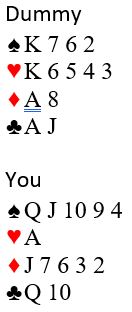
Counting your losers, you see one sure spade loser plus one possible loser each in clubs and diamonds. With no more than three losers, it looks like you will make your contract. But remember that overtricks are important in our pairs game.
How can you eliminate either a club loser or a diamond loser? One possible way is to play low and hope West has led from the king of clubs. But there is another way that is almost a sure thing, so don’t play too quickly to trick one. See if you can spot it before reading on.
Notice that you have the singleton ace of hearts in your hand. The king is in dummy. At trick two cash the ace of hearts. Go to dummy with the ace of diamonds. Cash the king of hearts, pitching that club loser! You will make five spades as long as LHO has at least two of the seven missing hearts.
Here is an interesting hand from yesterday. South opened one heart in 3rd seat. West overcalled two diamonds with a nice 5-5 holding in the minors, correctly bidding the higher-ranking suit first. North passed, and East found it difficult to act with a doubleton diamond and five cards in South’s suit.
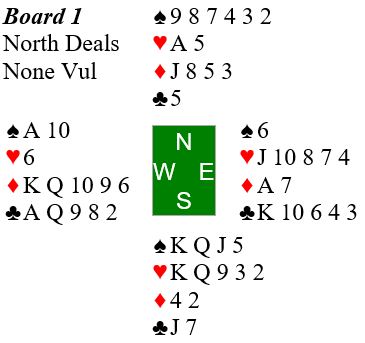
In the postmortem EW noticed their club fit. The hand would easily make six clubs their way. How do they find the club fit?
Had EW been playing the unusual 2NT convention, West would jump to 2NT rather than overcalling two diamonds. The jump to 2NT over an opening bid of one of a suit shows 5-5 in the two lower ranking unbid suits (diamonds and clubs in this case). It’s a useful convention that helps overcome situations like yesterday’s dilemma. Check out the link for guidance on how best to use unusual NT and how to respond to it.
Update below
Two passes to you. What’s your opening bid with this nice hand and 5-5 in the black suits?
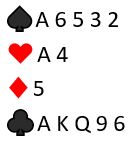
Your thoughts? My thoughts will be in update tomorrow.
Update: Most players would open this hand one spade, but I recommend one club. It’s a much better than minimum opening, and you will never lose the spade suit. I plan to bid and rebid spades at my next next two tuirns. Partner will know that I am at least 5-5 in the black suits, and it leaves open the possibility of game or slam in clubs. When you open the bidding plan your rebid.
Contrast the above with this hand from Sunday:
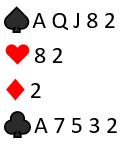
This hand I opened one spade in 1st seat. It’s a minimum opening bid, and this time spades are much better than clubs. I will not strain to bid the club suit at the three level if the auction becomes competitive.
You are South holding this hand:
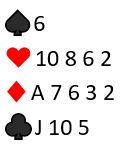
East deals and opens one spade. You pass (good call). LHO responds three clubs (alerted as a spade raise in the 8-10-point range, promising at least four spades). Your partner now overcalls three hearts and RHO tries to sign off at three spades.
It’s your call. Here is a summary of the auction:

What action do you take? First things first, how good is your hand in the context of the auction so far? Your partner has a nice hand with at least six hearts, so you have at least a 10-card heart fit. Opponents have minimum of 9-card spade fit, leaving partner with three or fewer spades. That singleton is a nice feature. Your other nice feature is the ace of diamonds. It looks like partner has at least nine tricks in hearts – 6 hearts, two spade ruffs and the ace of diamonds. Maybe your clubs will help her bring home a club trick. Time to be optimistic. Don’t give in to three spades. Bid four hearts.
I recently observed this hand:
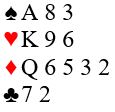
RHO opened one club in 1st seat and this hand overcalled one diamond. That’s an overcall that has nothing to gain and much to lose. It’s a lousy nine point hand. It does not interfere at all with opponents’ search for a golden major suit fit. It encourages partner to lead a diamond if LHO becomes declarer, ugh. Sure enough LHO became declarer and parter led a diamond, giving the opponents a top board.
My recommended partnership agreement is that a one diamond overcall be lead-directing with at least an almost opening hand. Overcalling with the junk above leaves partner with too much guess work about whether to compete or double for penalties.
There was lots of postmortem discussion on this hand the other day:
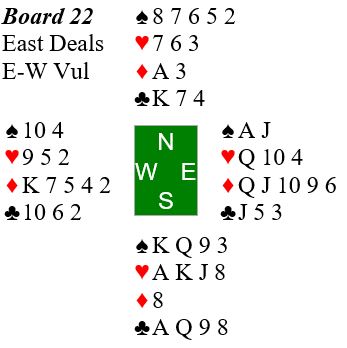
Nobody got to six spades, yet all were making six. How can you bid it? Answer is you cannot, and you should not. It only makes because of the lucky diamond features and location of heart queen. Moreover, spades are behaving nicely (West does not hold A J x of spades). Everything worked just right in this unlikely lie of the cards.
But say you gave North the diamond king rather than the king of clubs, so that the hand looked like this:
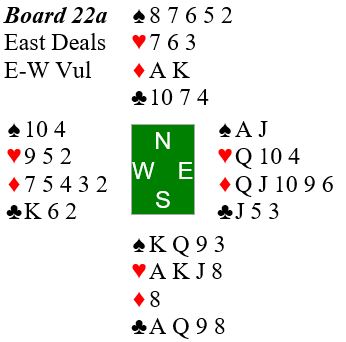
North’s hand is actually improved a bit with the marriage of top two diamonds. But there is no play for six spades in this layout. NS prospects are hampered by duplicative values in diamonds.
This revised hand (board 22a) illustrates the usefulness of splinter bids. South opens the bidding one club and North responds one spade (EW are silent). Now South splinters by jumping to four diamonds (one level higher than a jump shift)! The jarring nature of the jump by partner also jars the memory, so it’s easy to remember that you are playing splinters. The game-forcing splinter promises shortness in diamonds (singleton or void). North becomes aware of the duplicative values in diamonds and signs off in four spades.
Of course, you and partner must agree beforehand that you are playing splinters. Here is the relevant portion of the convention card:
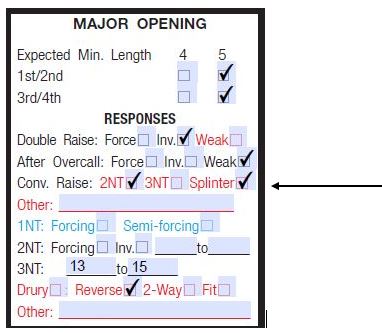
Notice that splinters (in red on the convention card) are alertable. You can often make a small slam with fewer that 33 points when partner knows that the shortness coveyed by the splinterer is a feature (e.g. not duplicative value).