Third Seat Opening

Posted on by 0 comment

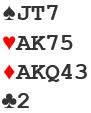
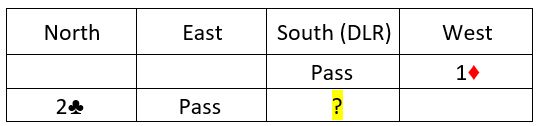
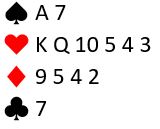
You are in 3rd seat vulnerable with this hand:

third seat

Should you open the bidding?

I suggest the answer is “yes”. You open one diamond and have a convenient rebid of two clubs. Sometimes it will turn out badly. But you will find a fit with partner in one of the minors well over half of the time, and your hand is then worth a good 13 points. You have set the stage for a competitive auction. It looks like they have the majors.

Value of a preempt

Posted on by 0 comment

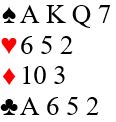
Preempts are meant to disrupt opponents communications with enough tricks in hand to prevent disaster. A good example occurred yesterday. Here is your hand vulnerable vs  not vulnerable:

preempt1

When you preempt it’s necessary to count your tricks. When vulnerable you want to be within 3 tricks of making your bid, within 4 tricks when not vulnerable. It looks like you have 4 tricks in spades and one and one-half in diamonds for five and one-half tricks. That’s too few vulnerable to bid three spades. Open the hand two spades, and you are within the requisite margin of safety. The only downside is that your partner is likely to lead an unhelpful spade if LHO buys the contract.

Bottom line when preempting with a weak hand: count tricks rather than points, and stay within the margin of safety (three tricks vul, four tricks not vul).

A Competitive Auction

Posted on by 0 comment

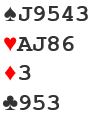
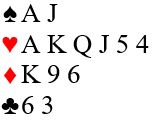
You pass in 1st seat holding this weak hand (unfavorable vul).

Oct6c

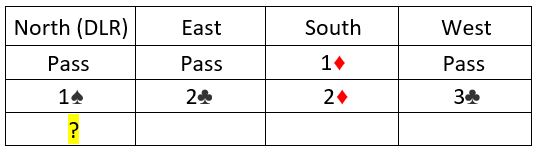
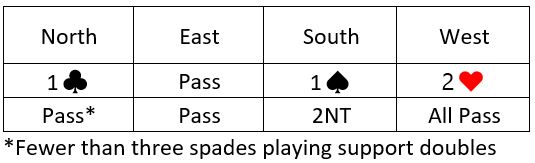
LHO passes, partner opens one diamond in 3rd seat, RHO passes, and you respond one spade. LHO now overcalls two clubs, partner rebids two diamonds, and RHO bids three clubs. It’s your turn. Bidding summary:

Oct6d

What do you do?

You sure hate to miss a possible heart fit. But your shortness in diamonds suggests a worrisome misfit. Should you go ahead and venture a bid of three hearts? If you do partner will know that you are at least 5-4 in the majors.

You have three clubs, so inference is that partner is short in clubs. Partner has promised at least six diamonds. Holding one club and six diamonds, partner has room for six cards in the majors. With that reasonable likelihood, it’s a good idea for you to compete with three hearts.


Minor Suit Slam

Posted on by 0 comment

Update below

You pick up this nice hand:

Oct6a

RHO passes in 1st seat and you open one diamond. Partner responds two diamonds (inverted minor suit raise showing 10+ points and no interest in the majors).

You rebid two hearts, showing control of the heart suit. After partner bids controls in spades and clubs you end up in six diamonds. Opening lead is the six of diamonds. (It’s often a good idea to lead trump in this situation to cut down a likely cross ruff by declarer.)

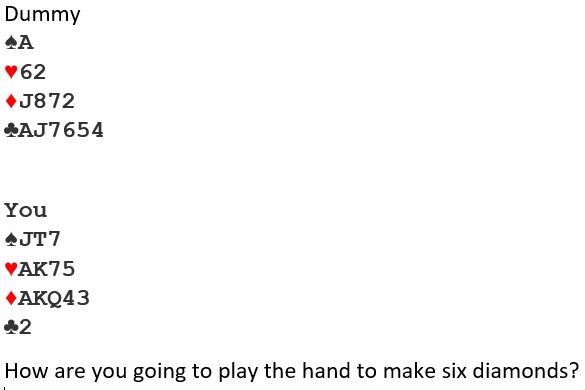
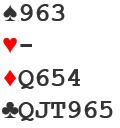
Here is the dummy and your nice hand:

Oct6b

My thoughts tomorrow. Stay tuned.

Update:

The most straightforward way to play this by ruffing two spade losers and one heart loser in dummy. You need to be careful on timing. I suggest the following sequence: win the opening lead in hand (saving the jack of diamonds to prevent an overruff of the heart), go to the ace of spades, back to the ace of hearts, ruff a spade low, back to the king of hearts, ruff your last spade low, cash the ace of clubs, ruff a club, ruff a heart with the jack, ruff a club high if an honor fell on the 1st club ruff on your left (otherwise ruff it low), cash a high trump to get you to 11 tricks. If trumps have broken 2-2 you are home. You last trump will win trick you the 12th trick. That sequence requires in worst scenario that clubs break no worse that 2-4 and that trumps are 2-2 (not worrying about unlikely problems in spades or hearts). It looks like a 60 percent slam.

You could also try for 13 tricks by setting up the club suit to pitch losers. It’s a useful exercise to give it a try on paper. Assume that you see the queen of clubs fall on your left as you ruff the 1st club.

Preempts by Responder

Posted on by 0 comment

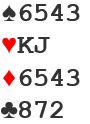
Your partner opens the bidding one diamond in 3rd seat. RHO passes. What do you do with this hand?

unit3

Before you answer, tell me the minimum number of hearts that are held by the opponents. If you answered nine hearts minimum, good for you. You’ve used the following clues:

  • Partner has at most four hearts (partner would have opened one heart with five).
  • You are void.
  • 13 hearts minus the maximum of four hearts on your side leaves the opponents with a minimum of nine hearts on their side.

Do you think it would be a good idea to impede their ability to find their heart fit?

You can do this is with a preemptive raise to three diamonds. 90 percent of the time your partner will have opened with four or more diamonds. This jump raise is known as an “inverted minor raise.” On your convention card you and parter agree to switch the meanings of the simple raise and the jump raise. By making the jump (rather than the single) raise, opponents will be hard pressed to find their heart fit at the three level.

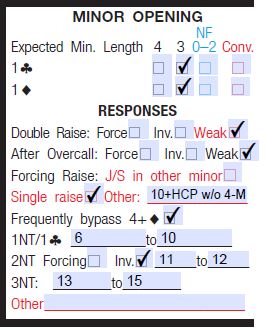
Here is what your convention card looks like when you and partner agree to play inverted minors:

inverted minor

Note that the double raise is weak and alertable. Also, the alertable single raise shows 10+HCP and no four card major.

Usually the double raise promises at least 5-card support for the opened minor, so it’s a bit riskier if you do it with only four. When the suit is diamonds you will end up with having an 8-card fit or better 90 percent of the time. I would roll the dice on this example and jump to three diamonds.

Opening Lead Problem

See undate below.

South opens 1NT ins 1st seat and North raises to 3NT. You must choose a lead from this hand:

unit2

You have only 4 points, so it’s likely your partner is not broke. How best to get partner off to the right start?

thoughts

Handling Interference

Update Below

Lot’s of interesting hands in today’s Unit Game. Here is one for you:

unit1

You are in 4th seat (favorable vul), and your partner opens one diamond. RHO overcalls two spades. What is your call?

First, how good is your hand in context of the auction so far? Singleton spade is a nice feature. You have three card support for partner’s suit, including two honors. You have five clubs, including King-Queen touching honors. I suggest it’s worth 11 or 12 points. Don’t you think you should bid? If so, what’s your call?

My recommendation tomorrow.

My recommendation: This is a perfect hand for a negative double. You promise at least four hearts and have clubs. Also, you would be happy if partner rebids her diamond suit.

Balancing in Direct Seat

In 2nd seat (none vul.) you hold:

balance1

RHO opens the bidding one club, taking away your opening bid. You wisely (in my view) decide to pass and await developments. LHO responds one heart, partner passes and RHO raises to two hearts. It’s your turn. Is it time for you to come into the auction? If so, what’s your bid?

It sounds like the opponents have found a heart fit of at least eight cards. That means your partner will have at most a doubleton in hearts, leaving at least 11 spaces in partner’s hand that can contain spades. Mike Lawrence gaves us the insight that you likely have a spade fit (because of the distributional value implied by your three little hearts!). You should pre-balance by bidding two spades. You likely have a fit, you’re only at the two level, and your high cards in the minors look like they are working.

Here is an earlier post in which I did not quite satisfy the logic for balancing in direct seat.

Good Bid, Partner!

I was sitting South and opened this minimum hand one heart in 1st seat:

good bid

Opponents were silent. My partner responded two clubs and my rebid was two diamonds.

Partner then jumped to three hearts, showing 3-card heart support and a slam invitational hand. My next bid was four hearts with my minimum.

Partner was still interested in slam and bid 4NT (Roman Keycard Blackwood 14-30). I bid five spades showing two key cards plus the trump queen. Partner then put me in a contract of six hearts.

Left hand opponent led the ace of spades and this was my dummy:

my dummy

Recall my hand:

good bid

At trick two LHO made the excellent shift to the seven of clubs. Should I play her for the king of clubs? She is putting me to an early guess! I decided I cannot make the contract without finessing for the king of clubs, so I put in the queen and it won. From there it was a matter of setting up dummy’s clubs for a diamond pitch or two (being careful not to get overruffed).

Play of a 1NT Contract

I often hear that 1NT contracts are especially difficult. Here is my thinking on a recent hand.

On this hand I was South in 1NT after my opening 1NT (15-17) in second seat was passed out:

1NT contract

West leads the six of spades. I play the queen and East contributes the two. Now I know who has the king of spades, and that spades are breaking 4-3. I decide to see if I can set up an extra trick in the club suit (I like the touching jack and 10 in dummy). That looks like best chance for another trick. It may work out even if clubs break 4-2.  The alternative of setting up an extra heart trick requires that hearts break 3-3 or the queen- jack is doubleton (about 38 percent chance altogether). I lead a low club toward hand, hoping that East has the ace. East plays the seven and my king wins (West playing the four). East has the ace! Two tricks are home for me.

Next I lead the five of clubs toward dummy, and West goes into a huddle. Now I know who has the queen. West plays the eight, I play the jack, and East wins the ace.

Back comes the 10 of spades and I win the ace.  Three tricks are home. Now I play the six of clubs and West wins the queen, East discarding a low diamond. I now know that West started with 4-4 shape in the black suits.

West now cashes the two top spades. I discard a heart on the 4th spade and so does East. West shifts to the jack of diamonds, East plays low, and I win the queen. Four tricks are home.

Next I lead six of hearts to the ace, both opponents following low. I cash the 10 of clubs, East discarding a diamond. Six tricks are home.

Next I go to hand to cash king of hearts and back to ace of diamonds for a total of eight tricks, making 2NT for +120.

Standard Use of a Cue Bid

Your partner opens the bidding with one spade in 2nd seat. Right hand opponent interferes with a Michaels cue bid of two spades (showing at least 5-5 in hearts and an unknown minor). You hold:

bid3

You have a nice spade raise, but the overcall has robbed you of bidding space (a nice feature of Michaels). How are you going to cope? You could bid three spades or three diamonds.

Instead I suggest you cue bid three hearts (hearts is RHO’s known suit). By doing that, you convey to opener that you have trump support and at least the values for a limit raise.

Bottom line: Cue bid of an opponent’s overcalled suit promises an invitational raise or better in your partner’s opened suit (usually a major). Since it has become standard practice for most players, the cue bid is not alertable in this situation. Notice also that it reserves the direct raise to three of partner’s major to show eight to a bad 10 points — very helpful to partner in deciding whether to press on to game.

It’s Your Call

You are in 4th seat (vul vs not vul) and player on your right opens one Spade. What action are you going to take with this unbalanced hand?

bid2

You could pass, but that doesn’t seem right with all that playing strength (those little spot cards are going to take tricks in a minor suit contract). You could overcall two diamonds, planning to bid clubs at your next turn. That’s what I did.

Also, I could have made an unusual notrump overcall of 2NT, promiising at least 5-5 in the minors (two lower unbid suits). What would you do?

I will follow up on this problem tomorrow.

What’s Your Call?

You are in 4th seat (both vul) and player on your right opens one club! What action are you going to take with this nice hand?

bid1

It sure looks like passing is a bad idea this time. But a double will surely elicit an advance in hearts, and that’s not what you want to hear. You cannot overcall two clubs, because partner would interpret that as Michaels. How about an overcall in one of your two 4-card suits?

Rate the following alternatives for your action:

  1. Make an overcall of one diamond
  2. Make an overcall of one spade
  3. Make a takeout double

Yesterday’s Game and Lesson

Hi, all:

We had another fun discussion of opening bids at yesterday’s lesson. I follow that up here with a post mortem on the game itself. It’s all about opening bids. Enjoy.

Four Hands on Bidding

See my updates for each hand below

Here are four hands from Sunday. 1st hand is from board 11:

You are South as dealer and pick up this hand with only 4 points, but it has 11 cards in the majors!

south11

You pass, hoping that partner has something.

The bidding goes:

bid11

How do you plan to advance your side of the auction from here?

Harry’s recommendation: your diamond void is a nice feature. Plan on bidding your majors in natural order, meaning the longer suit (hearts) first. A four point hand suddenly looks like a game force.

2nd hand is from board 16:

As dealer (vul. vs nonvul.) you pick up the following hand:

south16

You and partner are playing preemptive weak twos in the 5-10 HCP range. What is your call?

Harry’s recommendation: It looks overly optimistic to think your spade suit is going to provide the necessary 4 tricks vulnerable.  Pass!

3rd hand is from board 22:

Your right-hand opponent deals and opens the bidding one heart. What is your call holding?

hand22

Harry’s recommendation: Overcall one Spade. This hand is too good to pass, and your three little hearts make it more likely that partner will have a fit for you in spades. (HT: Mike Lawrence)

4th hand is from board 24:

As dealer you open the bidding one heart (none vul.) holding:

hand24

After two passes, right-hand opponent overcalls two clubs. You know your partner has fewer than six points. What do you say next to describe your huge hand?

Harry’s recommendation: Two alternatives here. With some of my partners I would cue bid three clubs. With others (who prefer to “bid where you live”) I would jump to three hearts to describe my big hand.


One more on defense

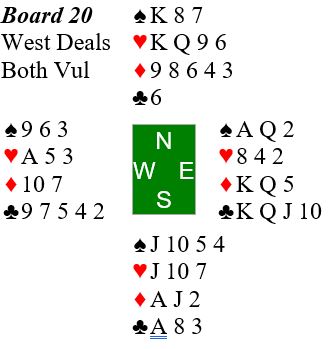
Here is one I did not concentrate well enough on yesterday (I will get to the bidding and declarer play posts tomorrow).It’s board 20.

Here is the entire hand:

board20

I lead a low spade against East’s 1NT contract. Partner plays the king and declarer wins the ace. Declarer starts the clubs and I hold off until the second round, partner showing out. I was worried about getting our tricks before declarer used his ace of hearts as an entry to the good clubs. But I wasn’t paying attention. I should be able to “see” that declarer has the clubs blocked. I need to remove the ace of hearts entry immediately to prevent him from taking that 4th club trick. I sure failed to use calories on this one!


Defense yesterday

Hi, all:

I have three posts based on yesterday’s game. The first one is on defensive strategy.

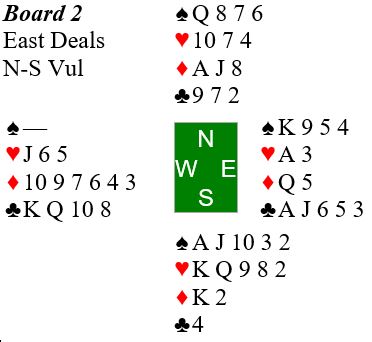
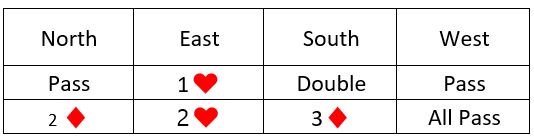
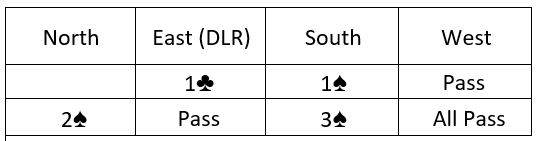
I was South declaring 3 spades on board 2 after the following bidding:
bid1

Here is the entire hand:

board2

I chose to overcall two spades rather than using the Michaels cue bid of two clubs, since my hand was in the intermediate range of 12 to 15 HCP. I was in the top of that range, so decided to raise to three spades to head off competition in the minors.

West made the good lead of the club king. How do you think East should defend?

East should be delighted with her trump stack, and should encourage continuation of clubs by playing the club six. The idea is to pump declarer (shorten his trump suit so that he loses control). That way it’s difficult to make three spades without looking at the hands. From the bidding declarer can “see” the missing high cards in East’s hand, in particular the ace of hearts and king of spades. What declarer cannot see, however, is the four-zero trump break.

BTW, notice that I could have made three spades by ducking the first three club leads. Dummy can ruff the 4th club, and careful play holds the opponents to three club tricks plus the ace of hearts.

Board 9 provides another lesson in defensive strategy.

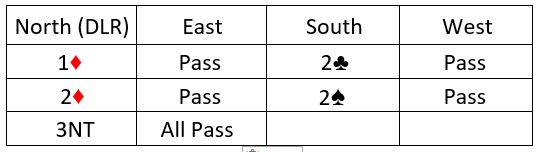
North arrives in 3NT on this bidding:
bid9

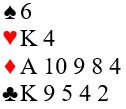
East leads the four of hearts from this crummy holding and observes this dummy:

west lead


Dummy1


It’s a good lead from the unbid suit, hoping to find your partner (who is not as broke as you are) with length and an entry after it’s set up. Partner plays the queen and North wins the ace of hearts. Next he finesses the queen of clubs which loses to the king. Back come the seven of hearts from partner which loses to North’s king. Dummy now runs the remaining five clubs. What do you discard from your hand on the last three clubs?


Do you remember the bidding? Hold on to those diamonds for dear life! Discard two hearts and a spade. Don’t give away overtricks at matchpoints by letting declarer set up his diamonds. This is known as maintaining parity with declarer.


Play Bridge to Lose Weight

Might work for us, toosmiley But perhaps only for Platinum LIfe Masters.

Category: Bridge News

Remaining Two Opening Lead Problems from Yesterday

Here are two more. These are more difficult. Please give me your thoughts in the comments.

Exercise 5. West’s Lead against contract of 2NT by South:

You are West holding:

hand11

Bidding:

bid5

Usually you would like to lead a heart from that nice holding with an outside entry. But the opponents may very well have the ace and jack of hearts, so your entry may be driven out before the hearts set up. You would like to get your partner in to lead a heart. Would you consider leading your singleton club? It’s unusual to lead a singleton against NT. How about a diamond? Your opening lead and why?

Exercise 6. East’s Lead against contract of 1NT by North:

You are East holding:

hand11

hand11


question


Three more opening lead problems

We had a good time discussing these three problems yesterday morning. Prior to talking about the problems, we reviewed the detective work involved in deciding on the correct suit to lead.

Exercise 4. East’s Lead against contract of Three Diamonds by North:

You are East holding:

hand11

Bidding:

bid4

Your opening lead and why?

This one’s pretty easy. I will post the other two a little later today. You’ll find them more controversial.