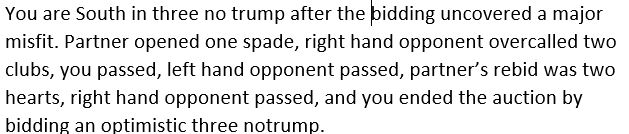
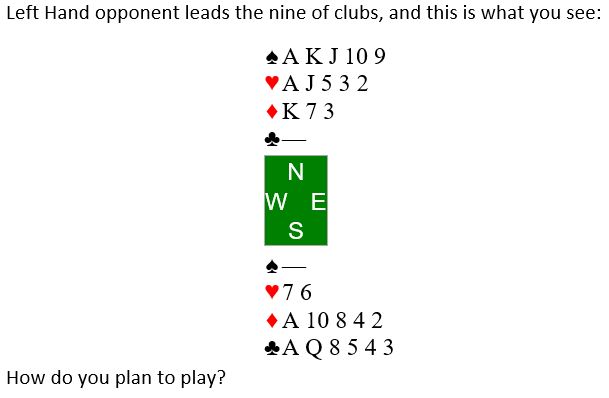
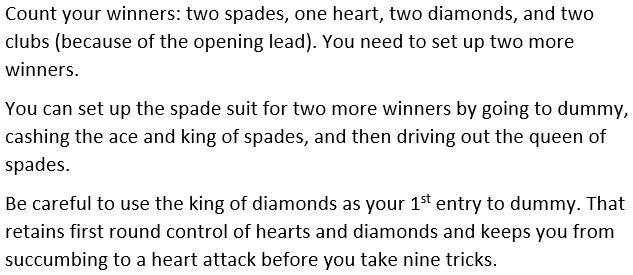
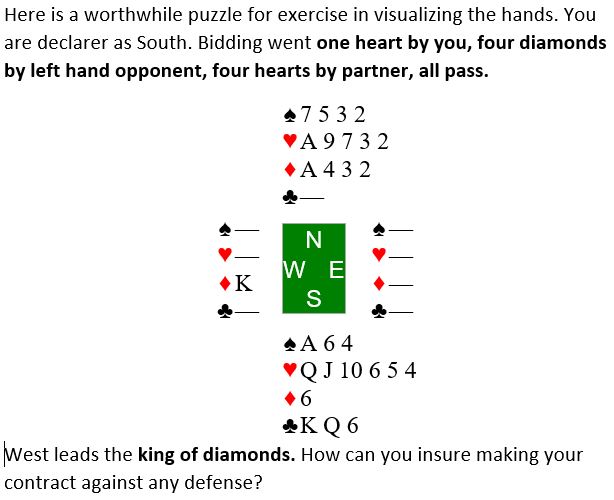
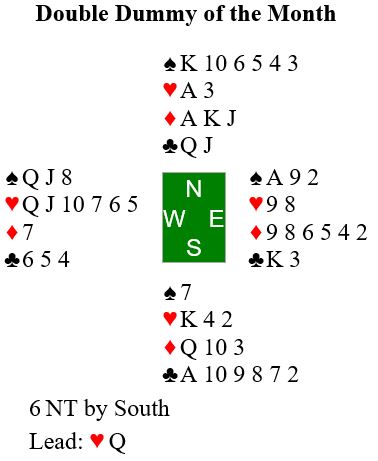
This one isn’t as hard as last month’s Double Dummy puzzle from hell. You are South in 6NT and opening lead is the queen of hearts. Take 12 tricks against any defense. Enjoy:
Hilo Bridge Club Updates
This one isn’t as hard as last month’s Double Dummy puzzle from hell. You are South in 6NT and opening lead is the queen of hearts. Take 12 tricks against any defense. Enjoy:
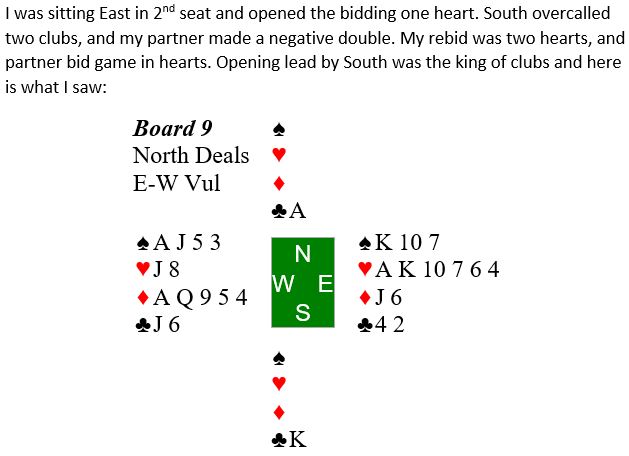

Here is a hand from Wednesday. I was sitting East with 12 points. Opponents were silent. My partner opened one diamond in 2nd seat, one spade by me, two diamonds by partner, three clubs by me, three hearts by partner, three notrump by me, and three passes.
South led the seven of hearts. I played low from dummy and my jack won the trick. I counted my sure tricks: two hearts, five diamonds and two clubs. At trick two I started running the diamonds, hoping that I could set up an overtrick in clubs. That was too lazy.
I forgot to remember an obvious inference for South’s heart holding from trick one. I should have made a mental note that South had to have the king, queen, nine, and perhaps one more in hearts. When I observed South discard the nine of hearts on the last diamond, I must lead the ace of hearts and out a heart to set up my 10 of hearts for a 10th trick. All the opponents can get is one heart and two spades.
BTW, I recommend that West rebid one notrump at her second turn. The two diamond rebid implies six diamonds.
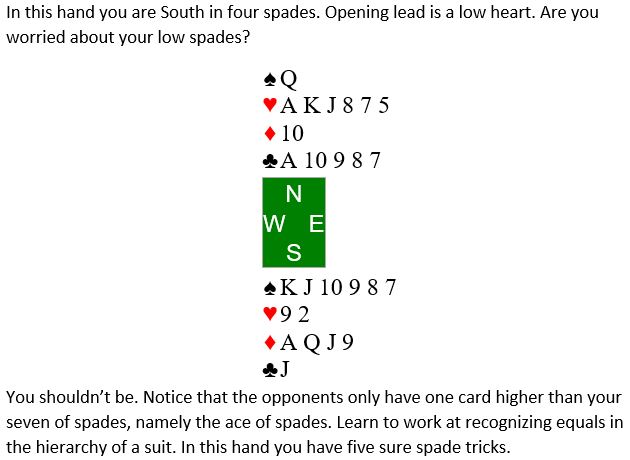
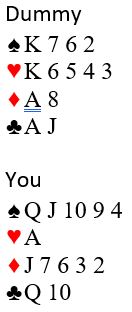
You are end up four spades with silent opponents. Partner splintered your one spade opening with four diamonds. The opening lead is the ace of diamonds.
Dummy

Lead: 
You
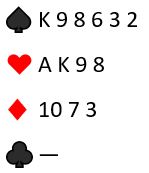
You count your losers: perhaps one spade if they break 3-0, one heart, one diamond and no clubs. But do you have enough trumps in dummy to ruff two diamonds and two hearts? Assuming spades break 2-1, how can you insure 11 tricks ?
Here is an exercise in counting the hand. Whether you are declarer or defender, counting helps you solve the mystery of missing honors. For example, you need to locate the missing club honors in this hand:

Dummy

Lead 
You

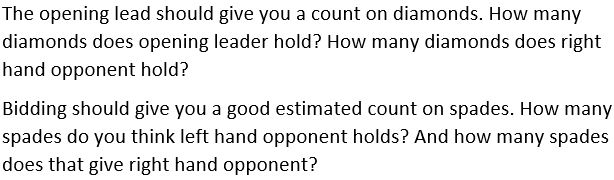
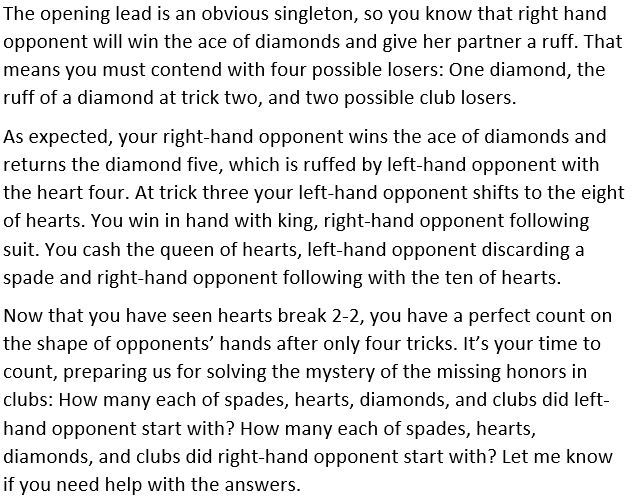
Once you give me the answers to those questions, we will be able do some more counting to investigate location of the missing honors in clubs. Stay tuned.
Is from Michael Berkowitz in the November Bridge Bulletin p.65: “At the bridge table, it can be very dangerous to forget the auction once the bidding cards have been put away.”
Here is one I stuggeled with a bit. You are in six hearts. Opening lead is the king of spades. Your mission is to make six hearts against any defense. Have fun!
See update below.

Once you have answered that question, you must decide how to reduce the number of losers while managing the trump suit. Give it some thought and I will elaborate later today.
Update: Overtricks are important in our pairs game. Whats’ you best chance to make three or four spades?
It looks like you have two potential losers in the trump suit, none in hearts, one in diamonds, and two in clubs. That gives you five potential losers. It looks like there is nothing you can do about losers in diamonds and clubs. How do you plan to manage the trump suit for no more than one loser?
Best chance is to finesse left hand opponent for the remaining two spade honors. If she has just one of them, you will reduce your potential spade losers to one. If she has them both, you may avoid a spade loser altogether. Use those hearts for entries to take spade finesses (it’s okay to overtake the king with the ace). You still don’t have any heart losers.
Question: What would you do differently if the queen of clubs was a small club?
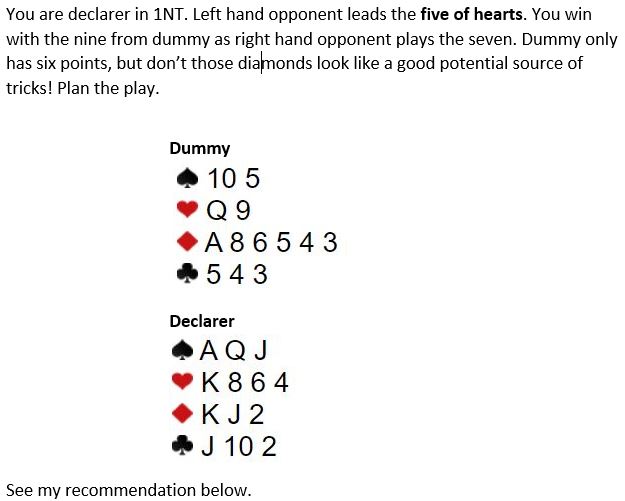
BTW, did you make a mental note of who has the remaining honors in hearts? And how many hearts do you think that player has? Did you use apply the rule of 11 at trick one?
Recommended line of play: You have a nine card diamond fit, so dummy’s diamonds should run if they split no worse than 4-0. You are in dummy, having won with the nine of hearts. Play a low diamond from dummy and insert the jack. Even if it loses to the queen, you know the diamond split is no worse than 3-1. And the remaining diamonds are sure to take tricks. You see how, don’t you? If not, please ask me.
When I observed the play on this hand declarer led the ace of diamonds at trick two, playing the two from his hand. It was not possible to recover after that. Bottom line: It’s right to recognize diamonds as your source of tricks, but make sure you retain an entry (the ace of diamonds in this example) to cash them.
Usually when playing a notrump contract, you aim to set up a long suit for more tricks. Setting up the suit requires that you have an entry to it once it is set up. And you often must give up a trick or two before your long suit gets set up. Here is a recent example:
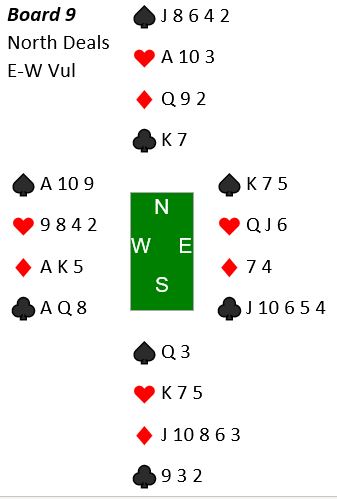
You are West in 3NT, and the opening lead is the spade four (4th highest from opponents’ longest suit). Counting your tricks, it looks like you have three sure spade tricks, two sure diamond tricks and one sure club trick for a total of six tricks. Once you drive out the king of clubs, the club suit looks like it may be a good source of more tricks.
But be careful of your entries to the clubs. The king of spades is a sure entry, so don’t squander it early. Win the opening lead in hand (you did play low from dummy didn’t you?). Start the clubs by leading the ace and then the queen. The only time you will have difficulty in setting up clubs for four tricks is the unlikely holding of all five missing clubs by one defender. As the cards lie you will easily take three spade tricks, two diamond tricks, and four club tricks for nine total.
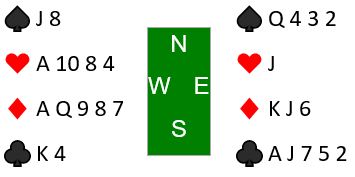
You are West in 3NT and opening leader leads the four of spades (4th highest of her spades). Here is your hand and East’s dummy:
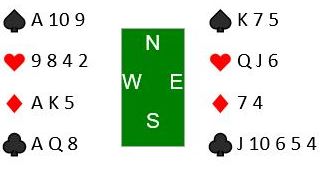
How many tricks do you expect to take in spades? The rule of 11 gives you the answer. By subtracting the rank of the suit led (the four) from eleven, you know how many cards higher than the four are held by you, dummy, and right hand opponent. 11 minus 4 equals seven. You can see six cards higher than the four: A 10 9 K 7 5. That means right hand opponent only has one card higher, so it must be the queen, the jack, the eight, or the six. When you play low from dummy you will know for sure which one it is. If it’s the eight or the six, your nine will win the trick. If it’s the queen or the jack, you will win the trick with the ace, and be in position to take a sure winning finesse against North’s remaining honor.
So, to answer the question, application of the rule of 11 informs you that you have three sure spade tricks.
Here’s another one for you double dummy aficionados.
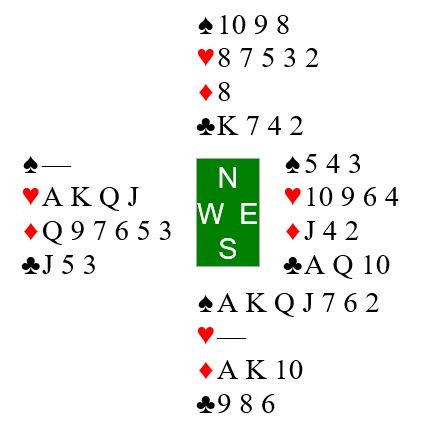
You are South in a contract of five spades. West leads the ace of hearts. That is the last error the defense will make, and they are not happy about it. It looks particularly ominous for you on Halloween Night: The ace, queen, jack, and 10 of clubs have your king trapped should West obtain the lead. Maybe you can somehow dig up an 11th trick in the graveyard.
First club member with fewer than 1,000 MPs to send me the solution wins a free play and recognition in our Double Dummy Solvers’ Honor Roll.
Tuesday I analyzed the play of a slam, concluding it had 75 percent plus chance to make.
But what if all of the relevant honors were indeed offside? In Tuesday’s hand that would place the ace of diamonds, the queen-ten third of hearts, and the king-jack of clubs offside. The deal would look like this. Update: thanks to Tor for pointing out error in the posted deal. I corrected it. Here is the corrected deal:
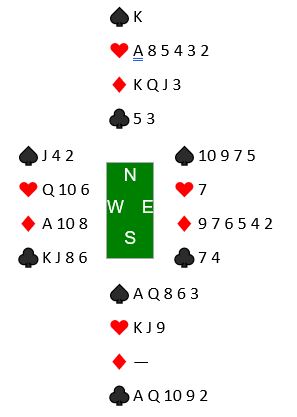
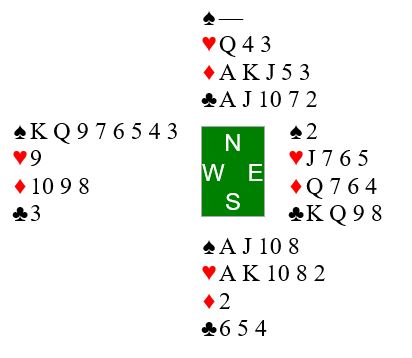
Now that you see all the hands can you find a way for South to make six hearts?
First HBC member with fewer than 1,000 masterpoints to solve this double dummy problem wins a free play and recognition in the HBC Double Dummy Solvers’ Honor Roll.
If you feel adventursome, propose your solution in the comments. Otherwise email the solution to me and I will get back to you.
I am offering the same prize to two previous Double Dummy problems that are still keeping HBC members awake at night: here and here.
See update below
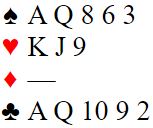
You end up in six hearts (opponents are silent) and left hand opponent leads the 10 of spades. Here is what you see after the lead:
Dummy
You
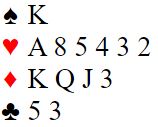
This is a good slam. What is your best chance to make it? Give it some thought and I will update a little later today.
Update: Counting your losers, you see one possible heart loser, one possible club loser and one possible diamond loser. You can avoid the club loser by pitching a low club on one of dummy’s spade winners.
One way to avoid the heart loser is to finesse for the queen of hearts, a 50 percent chance. Another way is to play the ace and king of hearts, hoping to drop the queen (a 52 percent chance missing four hearts). Playing for the drop has a little better chance of avoiding the heart loser.
Can you still make the slam if you don’t drop the heart queen? Yes, it depends on the location of the ace of diamonds. If left hand opponent has the ace of diamonds, you can finesse her for it by leading the king. If she does not cover the king with the ace, pitch a spade from dummy and hope she has the ace. If she does cover with the ace, you ruff in dummy (this is known as a ruffing finesse). If she does not have the ace you are down one. There is a 50 percent chance she has the ace.
Bottom line: This is a parcentage slam. It will make if you drop the queen of hearts or if the ruffing finesse in diamonds is successful. The likelihood of making the slam is roughly 77 percent.
Your partner opens 1NT (15-17) in second seat, and it’s hard for you to believe that you have this huge hand:
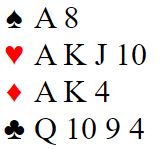
Where do you go from here? If your partner has 16 or 17 high card points you should be in a grand slam (16 plus your 21 equals 37, minimum for a grand). But what if your partner opened with 15 HCP?
Holding 15 points, it’s possible that your partner opened missing the ace of clubs, in which case you want to sign off in the small slam (15+21+4 for the ace equals 40). You will find that out by using the Gerber convention.
Once you are assured that partner holds the ace of clubs, she must have at least 11 other high card points. That leaves the opponents with at most four high card points, which must come from these cards: spades K Q J, hearts Q, diamonds Q J, and clubs K J. Those four points will be from either a queen and both jacks, or two queens, or a king and a jack. It looks like you will have a good play for the grand with most of those possible combinations. Notice that your hand is bolstered by the 10 9 of clubs and the married J 10 of hearts.
But shouldn’t you just be conservative and settle for the small slam. No, you should go with the percentages. Thats what the good players will be doing, so making an overtrick in a small slam is likely to award fewer than 50 percent of the matchpoints.
You are East in four spades. You dealt and opened one spade, partner responded two diamonds and you signed off in four spades with your six likely spade tricks plus the ace of hearts. South leads the seven of hearts. How do you plan to play?

Start by counting your losers. You have one club loser and one potential diamond loser. Spades will break 2-2 almost 41 percent of the time and 3-1 almost 50 percent of the time. When spades break 3-1 the queen will be singleton 1/4 of the time. By playing spades from the top the queen will drop 53 percent of the time, so it’s best to play for the drop in spades.
Assuming the queen does drop, what’s your best play for overtricks? You have finesses availabe for the ace of clubs and the king of diamonds.
The order in which you take the two finesses makes a difference. It’s best to finesse for the ace of clubs first. If it loses you can still fall back on the diamond finesse. But if you took the diamond finesse first and it lost, defenders could cash the ace of clubs immediately, holding you to 11 tricks. If the club finesse wins you can attempt the diamond finesse for 13 tricks. If it loses, you are still able to attempt the diamond finesse for 12 tricks.
Recommended sequence of plays: Let the opening lead ride around to your ace-jack of hearts (a free finesse). Cash the top two spades. When the queen drops begin by finessing for the ace of clubs as described above.
When you are in a suit contract it’s usually best to count your losers before you play to trick one. Here is an example from yesterday. You are South in a contract of four spades. West leads the four of clubs, and you see this layout:
Counting your losers, you see one sure spade loser plus one possible loser each in clubs and diamonds. With no more than three losers, it looks like you will make your contract. But remember that overtricks are important in our pairs game.
How can you eliminate either a club loser or a diamond loser? One possible way is to play low and hope West has led from the king of clubs. But there is another way that is almost a sure thing, so don’t play too quickly to trick one. See if you can spot it before reading on.
Notice that you have the singleton ace of hearts in your hand. The king is in dummy. At trick two cash the ace of hearts. Go to dummy with the ace of diamonds. Cash the king of hearts, pitching that club loser! You will make five spades as long as LHO has at least two of the seven missing hearts.