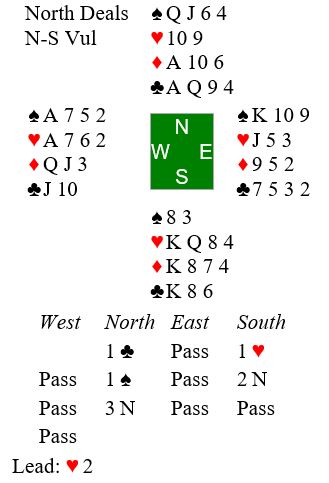
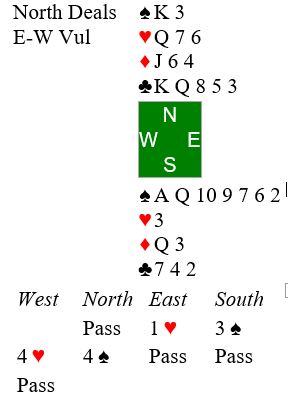
Blog Archives

Looking Ahead in the Auction

Posted on by 0 comment

You are in 2nd seat (vulnerable vs. NV). Right hand opponent opens preemptive three diamonds. You have this gorgeous hand, but bidding is already up to the three level.

It looks like you may have game or possibly slam in hearts. Most of the time that heart suit is going to bring in 8 tricks. How best for you and partner to find the right level in hearts?

You could double, planning to bid hearts later to show your big hand. Or you could bid four hearts immediately. Three hearts looks to be out of the question since you don’t want partner to pass. I chose to double. What would you do?

Decide on your call and I will tell you what happened below.

*

*

*

*

*

*

*

*

*

*

*

*

It did not go well for me. I failed to consider that left hand opponent might further the preempt. When West bid four diamonds, I suddenly realized that partner was likely to advance with four spades. That’s exactly what happened, and I was stuck trying to figure out what to do at the five level.

I should have bid four hearts at first turn. Preempts put the pressure on us, and I managed to put my partner in a difficult situation.
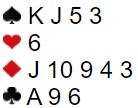
 

Overcall?

Posted on by 0 comment

It’s often a good idea to make an overcall at the one level. It usually helps partner get off to a good lead if you end up on defense. You may even find a safe partial contract, game, or sacrifice in a competitive auction. Overcalls interfere with opponents’ communication, particularly if the overcall is one spade. Overcalls don’t necessarily promise an opening hand. They are in the range of a good eight to seventeen points with most of the strength in the overcalled suit.

Here is a hand I do not recommend for an overcall:

overcall1D

Opening bid by right hand oppenent is one club. Do not overcall one diamond with this hand. Your stength is not in the diamond suit, so it would be misleading to partner. Moreover, it does not interfere with the opponents. They will have no problem finding a major suit fit if there is one.

Recommendation: When opponents open one club, do not overcall one diamond unless you have an opening hand. Make sure you discuss this with partner when going over your convention card.


It’s Your Response?

Posted on by 0 comment

My partner opened one spade in first seat (favorable vulnerability). My right hand opponent passed. I wondered how to respond with this hand:

I thought splinter (response of 4 hearts showing shortness) is out because of my singleton king of hearts.

The hand is not good enough for a game forcing raise of spades by responding 2NT (Jacoby). I did not want to encouage partner to investigate slam.

And the hand looks to good for a limit raise of 3 spades. I don’t want partner to pass the invitation.

My solution: respond 4 spades. I want to make sure we get to game opposite partner’s opening. I think Bergen would agree with treating my singleton for its shortness feature rather than its high card points.

How would you respond?


Take Advantage of Opponents’ Errors

Posted on by 0 comment

When opponents make an error, you need to make them pay. Can you make them pay on this hand? You are declarer in a contract of one spade. Here is the auction and what you see on opening lead of the 10 of diamonds:


The play goes as follows. At trick one you put in the queen without much hope, East covers with the king, and you win the ace.

At trick two you lead the jack of spades, won by East’s king with West following low.

At trick three East shifts to the eight of hearts, won in your hand with the ace.

At trick four you lead the 10 of spades, West following low and East showing out with the deuce of clubs.

At trick five you lead the three of clubs to dummy’s queen with both opponents following low.

At trick six you lead a low heart to your king, East following with the jack and West the four.

At trick seven you lead the nine of hearts, won by East’s queen with West following low.

At trick eight East leads the 10 of clubs and you win the ace with West playing the eight. The opponents have still not cashed their winning diamond! And you still must lose a trick to the ace of spades.

Here is the situation from your perspective with you on lead from hand at trick nine. How will you take advantage of opponents’ failure to cash their diamond winner?

I hope you did not get mesmerized by that king of clubs.

BTW, that was a risky vulnerable third hand opening bid by East. It worked out well for EW. West knew what to lead as a result. Here was East’s hand:

It’s Your Call

Posted on by 0 comment

You are in 1st seat, none vul., holding this hand:

What’s your call? Scroll down for my recommendation:

You have two quick tricks – the ace of hearts and two outside kings. You have a total of 10 cards in your two longest suits (hearts and spades). You have an easy rebid in hearts. Open the hand one heart. Don’t even consider preempting with this hand.

Think Before You Play to the 1st Trick

Posted on by 0 comment

You are South in a contract of 1NT. Here is the hand and auction:

Opening lead is the three of clubs. East play the Jack. Do you hold up or win the trick? Decide what to do. Then scoll down to see my recommendation:

I hope you won the trick. Notice the texture of clubs in dummy. The king and queen are only remaining cards ranking higher than dummy’s clubs. By winning the ace at trick one you are assured of two club tricks.


I hope you won the trick. Notice the texture of clubs in dummy. The king and queen are only remaining cards ranking higher than dummy’s clubs. By winning the ace at trick one you are assured of two club tricks.


Preempts!

Posted on by 0 comment

In 2nd seat (none vul.) I opened one diamond with a huge hand. Then my LHO (an expert) preempted four spades! Here was preemptor’s hand:

Do you like the preempt? In answering that question, think about how many tricks you might go down if doubled. In other words, how many tricks do you have with no help from partner? Also, think about where the opponents are likely to go in the auction. Scroll down for a summary of my thouights:


I love this preempt! Preemptor likely 5 tricks in spades and 1 or 2 tricks in clubs. That’s 6 and one-half tricks on your own. Give partner one trick and you will go down no more than three if doubled. Moreover, you have only 7 HCP while partner is a passed hand. Preemptor’s opponents certainly have game or slam in hearts. Make them guess at the five level. Preempts are difficult to deal with. Here was the entire hand (I was East):

As the cards lie our side can easily make 12 tricks in hearts for plus 480. Preemptor went down two doubled, holding us to the poor score of plus 300.

It’s Your Call

Posted on by 0 comment

You are South. Partner opens one club in 1st seat. RHO passes, and you respond one spade. Now West overcalls two hearts, and partner passes (minimum opening with fewer that three spades). RHO passes. What is your call with this hand?

Scroll down for my recommendation.


With your good 10 points you know the hand belongs to your side. Double asking partner to bid or leave double in with a heart stack.

Judgments in Bidding

Posted on by 0 comment

Here is an interesting hand observed recently on BBO. Would you open this hand in 1st seat (none vul.)?

It’s a close call. There is a lot to be said for striking the first blow. You have two quick tricks and it makes Bergen’s rule of 20 (11 HCP plus 9 cards in your two longest suits). However, Bergen would downgrade for the ugly doubleton quack in diamonds. Offsetting that, you can add a point or two for length in clubs (but downgrade a little for crummy texture in the long suit). Bottom line is that the majority of good players would likely open the hand one club.

What would you do?


Another on Counting your Losers

Posted on by 0 comment

You opened one heart in 2nd seat and West overcalled two diamonds. Partner had enough strength to make a negative double at the two level. Having 5-5 in the rounded suits increased the value of your hand. So, you were willing to go to three clubs for your rebid. Partner took the suit preference for hearts and you bid game. Opening lead was the king of diamonds.


Here is what you saw summary of the bidding:

You were in a good contract. How would you play to make four hearts? Your thoughts on opening lead:

  • West should have the ace of hearts.
  • Other than that you have the remaining high hearts.
  • You have the top three clubs, and there is a good chance they will split no worse than 4-2 (84%).
  • You should lose no more than two spades and the ace of hearts.
  • Hearts should split no worse than 4-2 (84%).

Do those clues shed light on how you should play? Please let me know by email or in comments if you are unclear on what to do at trick two.

Counting your losers in a suit contract

Posted on by 0 comment

You are South in a contract of three hearts doubled. Here is the auction and what you see when West leads the queen of clubs:

East overtakes with the club king and continues with the ace at trick two. Counting losers, you have two hearts, one diamond, and one club. The problem is you may lose trump control as defenders force you to ruff clubs. The good new is you are reasonably sure that East has the ace and queen of hearts. The bad news is that you need to get to dummy twice to finess of the ace and queen of hearts. Also, East may well have four hearts.

It looks like you will need the king of diamonds to be onside. So, you might as well make that assumption.

What card do you play at trick 3? (Remember that your are worried about losing trump control.)

I recommend discarding a diamond at trick two. That makes life difficult for East. She cannot continue clubs because dummy is now void. If she shifts to a spade you let it ride to dummy’s king. Now you can lead the 8 of hearts, expecting to to win or drive out one of East’s honors. Either way you are in control.

Similarly if she shifts to a diamond you will let that ride to dummy and play as before. You may even make an overtrick: three spades, four hearts, and three diamonds.

Here was the entire hand:


Competitive Auction

Posted on by 0 comment

South opened one diamond in 1st seat (vulnerable vs not) at matchpoints. West overcalled two clubs and South jumped to three diamonds with his rock crusher. West competed to four clubs. Refusing to give up, South bid four diamonds. East doubled for penalty, ending the auction. Here is South’s hand with a summary of the auction.

Do you agree with South’s action? Scroll down to see what happened.


South was too aggressive, falling in love with his huge hand. Partner understood South’s bids, but remained silent. Moreover, East is likely to have a diamond stack since West has at least seven clubs. When the dust settled South was down four for minus 1100. South should let West play four clubs for minus 130 for NS and an average plus for NS.

Using clues from the bidding to guide your play

Posted on by 0 comment

You are South declaring three diamonds after West makes a preemptive jump to two spades over your opening bid. West leads the three of spades. Here is what you see with a summary of the auction:

Trick 1: You win the king of spades, East playing the jack.

Trick 2: Then you cash the ace of clubs, both following.

Trick 3: You then lead the eight of clubs, ruffing low in dummy.

Trick 4: Next comes the three of hearts from dummy and you put in the eight, losing to West’s jack.


At trick 5 West shifts to the four of spades. What spade do you play from hand? Scroll down for the answer.


Solution: Play the nine of spades, knowing it will get ruffed. West started with six spades for the preemtive overcall. You and dummy started with a combined total of six spades. East’s jack at trick one had to be a singleton. Don’t let your ace of spades get ruffed!

Visualizing the unseen hands

Posted on by 0 comment

You are South, having ended up in a contract of three hearts. East opened the bidding in 1st seat with one spade, and you overcalled two hearts. From there it was an interesting competitive auction, during which West and North indicated weak hands by their reluctance to bid. West leads the king of spades. Here is what you see, including details of the auction:

Trick 1: You won the ace of spades.

Trick 2: You cashed the ace of hearts.

Trick 3 you gave up a spade to East.

Trick 4 East then cashed the king of hearts, West discarding the deuce of diamonds. (See details of 1st 4 tricks above.)

At trick 5 East shifts to the three of clubs. It’s your turn: Use clues from the bidding and play to decide which card to play from hand. Scroll down to see the solution.


Solution: You know from the auction that East has the ace of clubs. Play the queen of clubs and it wins. Once you get to dummy again you will lead another club, putting in the king if East follows low. You are assured of two club tricks, knowing that the ace of clubs is onside.


What’s your call?

Posted on by 0 comment

You are South in third seat with both sides vulnerable. Partner passes and East opens the bidding one club. It’s not often you get dealt a nine card suit. Here is your hand:

What’s you call and your plan for the remainder of the auction?

It looks like the opponents may have a game, particularly in hearts. You have 9 and 1/2 tricks. My recommendation is for you to jump to five diamonds. Five diamond might even make. Yes, that call might turn into a disaster, but it’s best to put opponents to the guess at the five level.


Opening Lead?

Posted on by 0 comment

You are on opening lead. Here is your hand and the auction:

What card do you lead?

 Spades look like the best suit to attack. But be careful not to mistakenly lead the king of spades. Fundamental for this holding is to lead the queen, asking partner to play the jack if she has it. If you don’t see the jack when dummy comes down and partner doesn’t play it, then you know declarer has it. The jack will then be trapped between your king and 10.

The Power of 10s, 9s, and 8s

Posted on by 0 comment

Recommendation for newer players: pay attention to the hierarchy of cards in each suit during play. It’s much easier than you might think. The hierarchy itself facilitates recall of cards played (known as “watching the spots”). The idea is to keep track of cards that are rising to the top in trick taking power. Of course, practice is essential to developing the skill! But with a little practice it becomes easy.

Here is a prime example. I was North and fortunate to have a partner adept at watching the spots:

watching spots

You may wonder why I decided to accept partner’s invitation to game with “only” 13 HCP. Look at my (North’s) spots: 13 HCP plus a pair of married 10s and 9s to contribute to our trick taking. Perhaps I was a bit lucky when my partner showed up with all four (yes, 4!) 8s.

Now watch what happened. Heart deuce was led, and declarer used the rule of 11 to deduce that East had at most one card higher than the eight. When East played the jack South could count three sure winners in hearts. The outstanding ace of hearts was the only card higher than those in South’s collection. When the dust settled South had come to 10 tricks: one spade, three hearts, two diamonds, and four clubs. 10 tricks on 24 combined HCP bolstered by those trick taking 10s, 9s, and 8s. Cards take tricks, not HCP points.

Watch those spots and take advantage of your intermediates. Don’t miss out on opportunities presented.

Watch those Spots!

Posted on by 0 comment

The play by South seemed pretty routine on this one. It looks like South will lose one heart, two diamonds, and perhaps two clubs and one spade.

spot watching

The ace of hearts was led by West, and South ruffed the next heart. Then South led a spade to the king and another back to hand, revealing a 2-2 break. At trick 5 South led a low club toward dummy, 10 from West, queen from dummy and won by East’s ace.


At trick 6 East continued with the king of hearts and North ruffed. At trick 7 declarer led a low club toward dummy’s king, West playing the jack and East the nine!

I watched in horror as declarer led a low club to seven in hand. To declarer’s surprise it won the trick. Declarer had not been watching the club spots. Cashing the eight of clubs and the remaining two clubs would bring in 11 tricks for a top board.

East erred by playing the nine of clubs when also holding the six.

South and East were not paying attention to the hierarchy of cards in the club suit. It’s hard to get newer players out of the mindset that any card lower than a 10 is “x” and inconsequential. It’s the hierarchy itself that facilitates remembering which card has risen to the top in trick taking power. After two rounds of clubs in this hand the eight had risen to boss club.


Best sentence I read today

Posted on by 0 comment

It’s from Chip Dombrowski writing in the latest edition of the ACBL District 20 newsletter Trumpet. Concluding from West’s takeout double that East cannot have any of the missing honors, Chip puts in the queen of hearts from dummy. When East wins the trick with the heart king Chip comments:

It is one of my great pet peeves when people turn up with cards they are known not to have.

We have all experienced that peeve. It seems to occur at least twice every session on BBO.

How Will the Missing Cards in a Suit Break?

Posted on by 0 comment

Karen Walker has posted a useful table of probabilities here.

I suggest you become familiar with it. For example, you often come up with a problem such as how five missing will spades split between East and West. Answer: spades will break 3-2 68 percent of the time, 4-1 28 percent of the time, and 5-0 4 percent of the time.